(Image source from: x.com/BCCI)
India is heavily favored to defend their title in the home T20 World Cup, but they might face challenges like losing the toss and having to bat on a wet pitch during a humid night. This situation occurred on the first night of their ten-match preparation for the World Cup, and they handled it brilliantly. Hardik Pandya excelled despite the tough conditions, scoring 59 runs off 28 balls and pushing India to a total of 175, even as many other players struggled. The bowlers capitalized on the pitch's conditions to dismiss South Africa, who ended up with their lowest score ever in T20I matches. Winning by 102 runs after losing the toss should send a warning to other teams. From the very first ball, it was clear that India faced a challenging pitch, which would improve as the night progressed. Shubman Gill, back from a neck injury, and captain Suryakumar Yadav both ended up hitting easy catches to mid-off and mid-on against Lungi Ngidi.
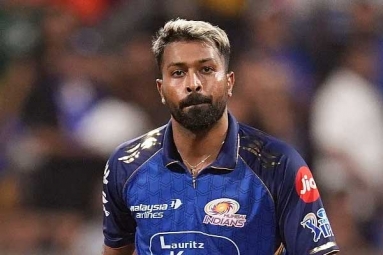
India included three left-handed batsmen in the middle order to possibly postpone the introduction of Keshav Maharaj, but none of them – Abhishek Sharma, Tilak Varma, and Axar Patel – could get going. Tilak and Axar managed a combined score of 49 runs off 53 balls as the tall fast bowlers from South Africa maintained a high bounce from the pitch. Abhishek, who struggled to get the ball early on, was caught by Marco Jansen, ending his innings at 17 runs off 12 balls. When Hardik came to the crease at 78 for 4 in the 12th over, it seemed likely India might end up with a low score on a pitch that would become faster and more favorable with the dew. Aiden Markram thought he could bowl Maharaj with Hardik scoring roughly at a run per ball against left-arm spin throughout his T20 career. However, on this night, Hardik hit two impressive no-look sixes off Maharaj, sparking India's recovery. Anrich Nortje had been challenging for the others, but Hardik hit two fours off him: one exploiting his speed and another as an off-drive after charging at him. He helped India score 30 runs in the last two overs, as everyone except Jansen saw their bowling figures take a hit. The ramp shot off Nortje that brought him to his fifty made Hardik only the fourth Indian player to reach 100 T20I sixes.
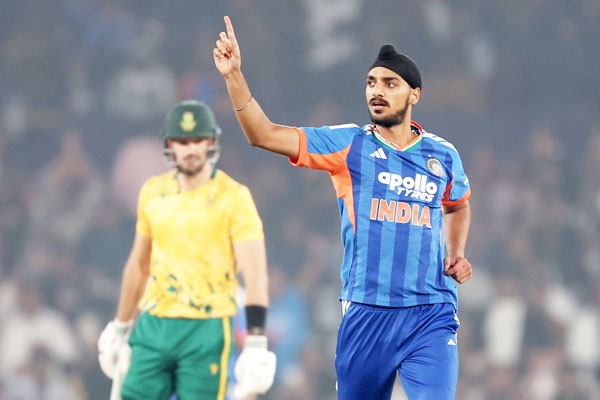
India had to take advantage of the short time when the new ball moved if they wanted to stand a chance on a pitch that was likely to improve. It really did seem to get better based on how Tristan Stubbs connected with the ball, but Arshdeep Singh provided India with the crucial start they required. He first took Stubbs out by bowling Quinton de Kock for a duck with an away-swinging delivery that also moved off the seam. In his second over, Arshdeep started using a wobble-seam technique, which led to Stubbs being dismissed for 14 runs off 9 balls, with Jitesh Sharma making the first of three impressive catches. Batting seemed easier than it had in the first innings, but India never went more than 16 balls without taking a wicket. The only time there was a 16-ball partnership was when Dewald Brevis got the better of Varun Chakravarthy in the fifth over, but Markram went back to an Axar delivery and was bowled out hitting the leg stump.
Hardik not only excelled in batting but also took out David Miller with his first ball: Jitesh caught an inside edge that hit Miller's pad while diving forward. Varun then dismissed both Donovan Ferreira and Marco Jansen, with one out through a fast ball and the other with a slower delivery. The wickets kept falling, and Jasprit Bumrah achieved his 100th T20I wicket, becoming only the fifth bowler in history to reach that mark in all formats. Shivam Dube, likely chosen for the team ahead of Rinku Singh due to his bowling, gave the team management one last moment of joy with the final wicket of the evening.